Rationale Funktionen Polstellen: Unterschied zwischen den Versionen
| Zeile 22: | Zeile 22: | ||
Ist n ungerade, dann hat die Funktion <math>f:x\rightarrow \frac{1}{(x-x_0)^n}</math> mit <math>D = R\backslash \{x_0\}</math> an der Stelle <math>x = x_0</math> einen '''Pol mit Vorzeichenwechsel'''. | Ist n ungerade, dann hat die Funktion <math>f:x\rightarrow \frac{1}{(x-x_0)^n}</math> mit <math>D = R\backslash \{x_0\}</math> an der Stelle <math>x = x_0</math> einen '''Pol mit Vorzeichenwechsel'''. | ||
| + | |||
| + | Die Ordnung der Polstelle <math>x_0</math> ist gibt an wie oft <math>x_0</math> Nullstelle des Nenners (des gekürzten Bruches) ist. | ||
}} | }} | ||
| Zeile 48: | Zeile 50: | ||
c) x = 2; Pol 2. Ordnung; Pol ohne Vorzeichenwechsel; Annäherung von links (x<2): <math>h(x) \rightarrow \infty</math>; Annäherung von rechts (x>2): <math> h(x) \rightarrow \infty</math> | c) x = 2; Pol 2. Ordnung; Pol ohne Vorzeichenwechsel; Annäherung von links (x<2): <math>h(x) \rightarrow \infty</math>; Annäherung von rechts (x>2): <math> h(x) \rightarrow \infty</math> | ||
| − | d) x = 3; Pol 7. Ordnung; Pol mit Vorzeichenwechsel; Annäherung von links (x<3): <math>k(x) \rightarrow -\infty</math>; Annäherung von rechts (x>3): <math> k(x) \rightarrow | + | d) x = 3; Pol 7. Ordnung; Pol mit Vorzeichenwechsel; Annäherung von links (x<3): <math>k(x) \rightarrow -\infty</math>; Annäherung von rechts (x>3): <math> k(x) \rightarrow \infty</math> |
e) x = -2; Pol 1. Ordnung; Pol mit Vorzeichenwechsel; Annäherung von links (x<-2): <math>l(x) \rightarrow \infty</math>; Annäherung von rechts (x>-2): <math> f(x) \rightarrow -\infty</math><br> | e) x = -2; Pol 1. Ordnung; Pol mit Vorzeichenwechsel; Annäherung von links (x<-2): <math>l(x) \rightarrow \infty</math>; Annäherung von rechts (x>-2): <math> f(x) \rightarrow -\infty</math><br> | ||
Version vom 4. April 2013, 10:24 Uhr
Die Funktion  ist für
  nicht definiert. Wie verhält sie sich in der Umgebung von
  ? Je kleiner
  betragsmäßig wird, desto größer wird der Betrag von
  . Zeigt eine Funktion für einen x-Wert ein solches Verhalten, dann ist der x-Wert eine Definitionslücke und man bezeichnet diese Stelle als Polstelle.
 Merke Merke
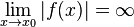
Ist an einer Definitionslücke
dann ist die Definitionslücke |
 einer gebrochen-rationalen Funktion
  ,
,
Beispiele:
1. Die Funktion hat für einen Pol 1. Ordnung ( ist einfache Nullstelle des Nenners).

Nähert man sich von links an, also  mit
mit  , dann streben die Funktionswerte nach
  ; nähert man sich von rechts an, also mit
  , dann streben die Funktionswerte nach
  .
.  hat an eine Polstelle mit Vorzeichenwechsel. Die Gerade ist senkrechte Asymptote des Graphen von .
2. Die Funktion  hat für einen Pol 2. Ordnung ( ist zweifache Nullstelle des Nenners).

Nähert man sich von links oder von rechts an, also mit oder , dann streben die Funktionswerte in beiden Fällen nach .  hat an eine Polstelle ohne Vorzeichenwechsel. Die Gerade ist senkrechte Asymptote des Graphen von .
| Merke
Man kann allgemein für eine gebrochen-rationale Funktion Ist n gerade, dann hat die Funktion Ist n ungerade, dann hat die Funktion Die Ordnung der Polstelle |
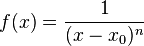 formulieren:
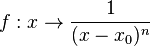 mit
mit  an der Stelle
  einen Pol ohne Vorzeichenwechsel.
 Aufgabe Aufgabe
Ermittle bei den gegebenen Funktionen jeweils die Polstelle(n) der Funktion und beschreibe das Vorzeichenverhalten der Funktion bei Annäherung an die Polstelle(n). a) b) c) d) e) |
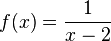
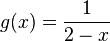
 mit
mit 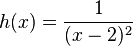
 mit
mit 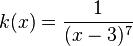
 mit
mit 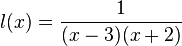
a) x = 2; Pol 1. Ordnung; Pol mit Vorzeichenwechsel; Annäherung von links (x<2): 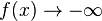 ; Annäherung von rechts (x>2):
b) x = 2; Pol 1. Ordnung; Pol mit Vorzeichenwechsel; Annäherung von links (x<2):  ; Annäherung von rechts (x>2):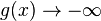
c) x = 2; Pol 2. Ordnung; Pol ohne Vorzeichenwechsel; Annäherung von links (x<2):  ; Annäherung von rechts (x>2):
d) x = 3; Pol 7. Ordnung; Pol mit Vorzeichenwechsel; Annäherung von links (x<3): 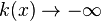 ; Annäherung von rechts (x>3):
e) x = -2; Pol 1. Ordnung; Pol mit Vorzeichenwechsel; Annäherung von links (x<-2):  ; Annäherung von rechts (x>-2):
 ; Annäherung von rechts (x>3):